![[ Click Here to Enter an Alternate Text for this Image ]](/data//sites/default/files/report_2387/images/image_file_0_FirstPageImage_1112020842.jpg)
Suicide is an avoidable cause of mortality that is a tragedy for all involved—families, friends, neighbors, colleagues, and communities. In 2013, suicide was the 10th leading cause of death in the United States overall, with more than 41,000 deaths by suicide.1 Among people aged 15 to 24, suicide ranked even higher as the second leading cause of death.2
However, individuals who die from suicide represent a fraction of those who consider or attempt suicide. Research suggests that there are more attempted suicides than there are deaths from suicide.3,4 Out of every 31 adults who attempted suicide in the past 12 months in the United States, there was 1 death by suicide.5 In addition, people are likely to have thought about suicide before actually attempting suicide. Suicide is of particular concern for young adults because the percentage of adults having serious thoughts of suicide in 2014 was higher among young adults aged 18 to 25 than among adults aged 26 to 49 and adults aged 50 or older (7.5 percent vs. 4.0 and 2.7 percent, respectively).6 Assessing recent state-level trends in past year serious thoughts of suicide among young adults helps state public health authorities and suicide prevention specialists to better understand and effectively serve their communities.
The National Survey on Drug Use and Health (NSDUH) has information on suicidal thoughts and behavior at the state level. This issue of The CBHSQ Report uses data from the 2013 and 2014 NSDUHs to present state (including the District of Columbia) estimates of serious thoughts of suicide in the past year among adults aged 18 to 25. The estimates in this report do not reflect information from adults whose suicide attempts in the past year were fatal. All estimates in this report are based on a small area estimation (SAE) methodology in which state-level NSDUH data are combined with local-area county and census block group/tract-level data from the state to provide more precise estimates.7 Findings in this report are annual averages based on combined 2013–2014 NSDUH data from 39,000 adults aged 18 to 25. The 2012 and 2013 data are based on information obtained from 45,200 young adults.8
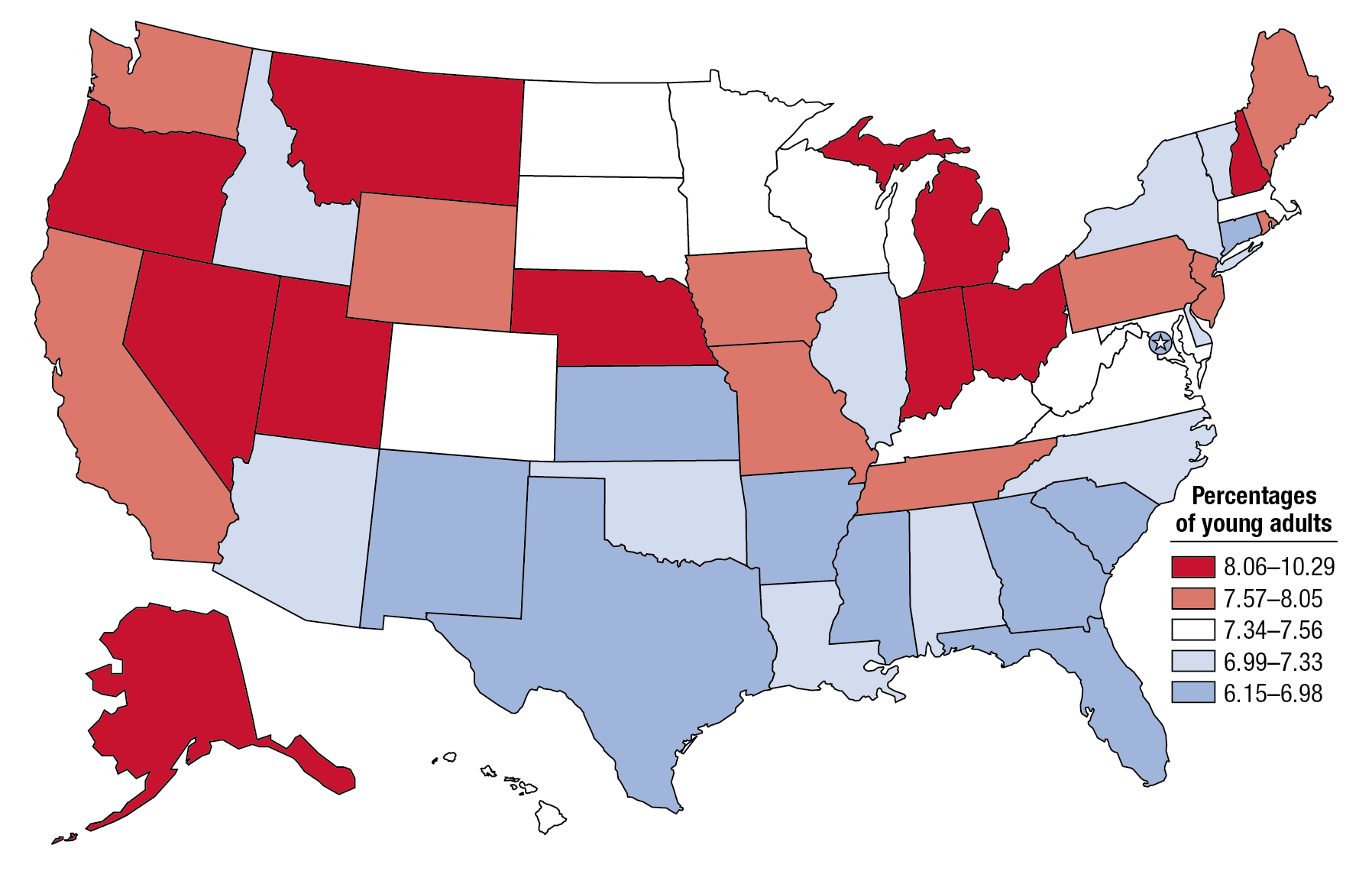
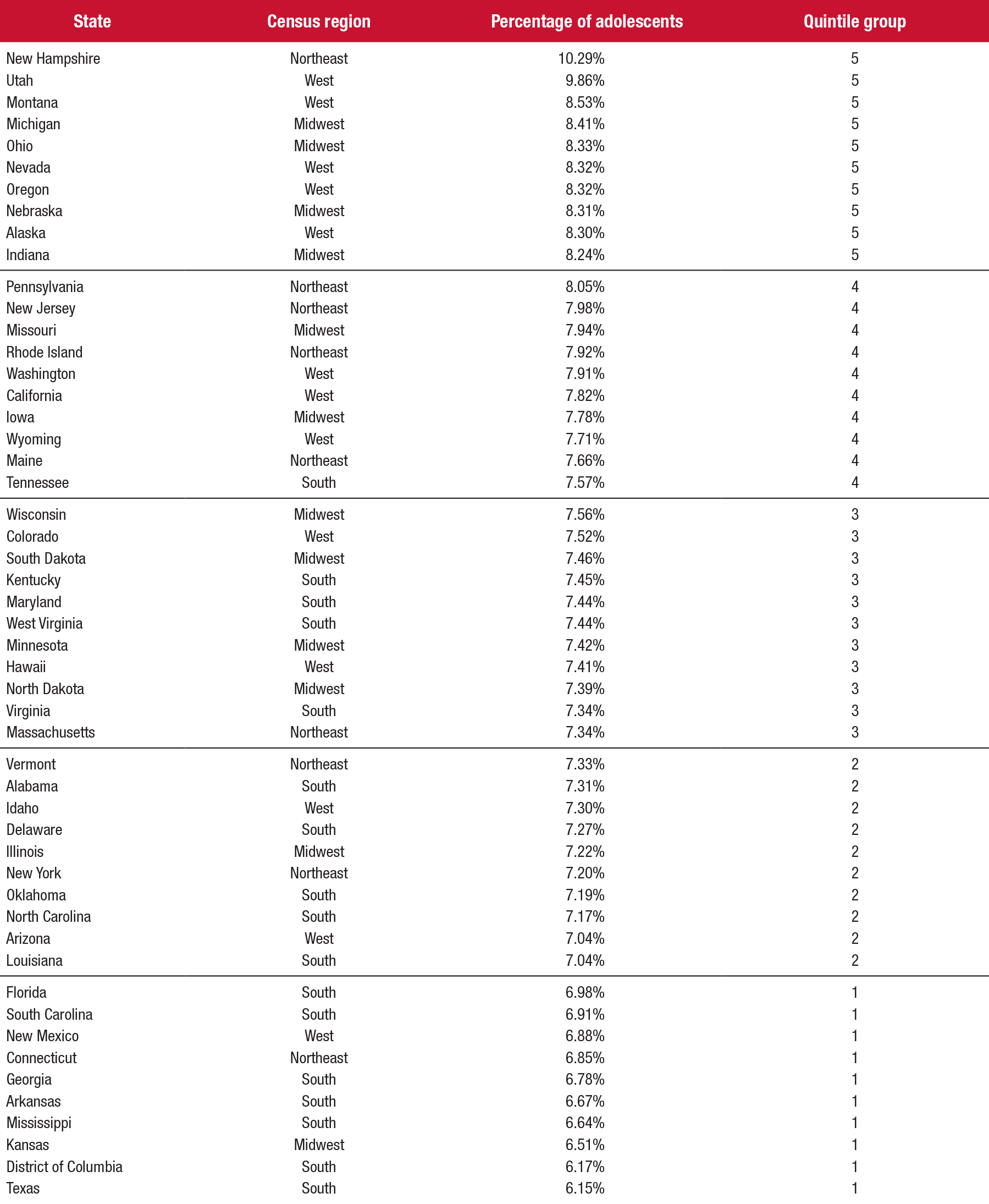
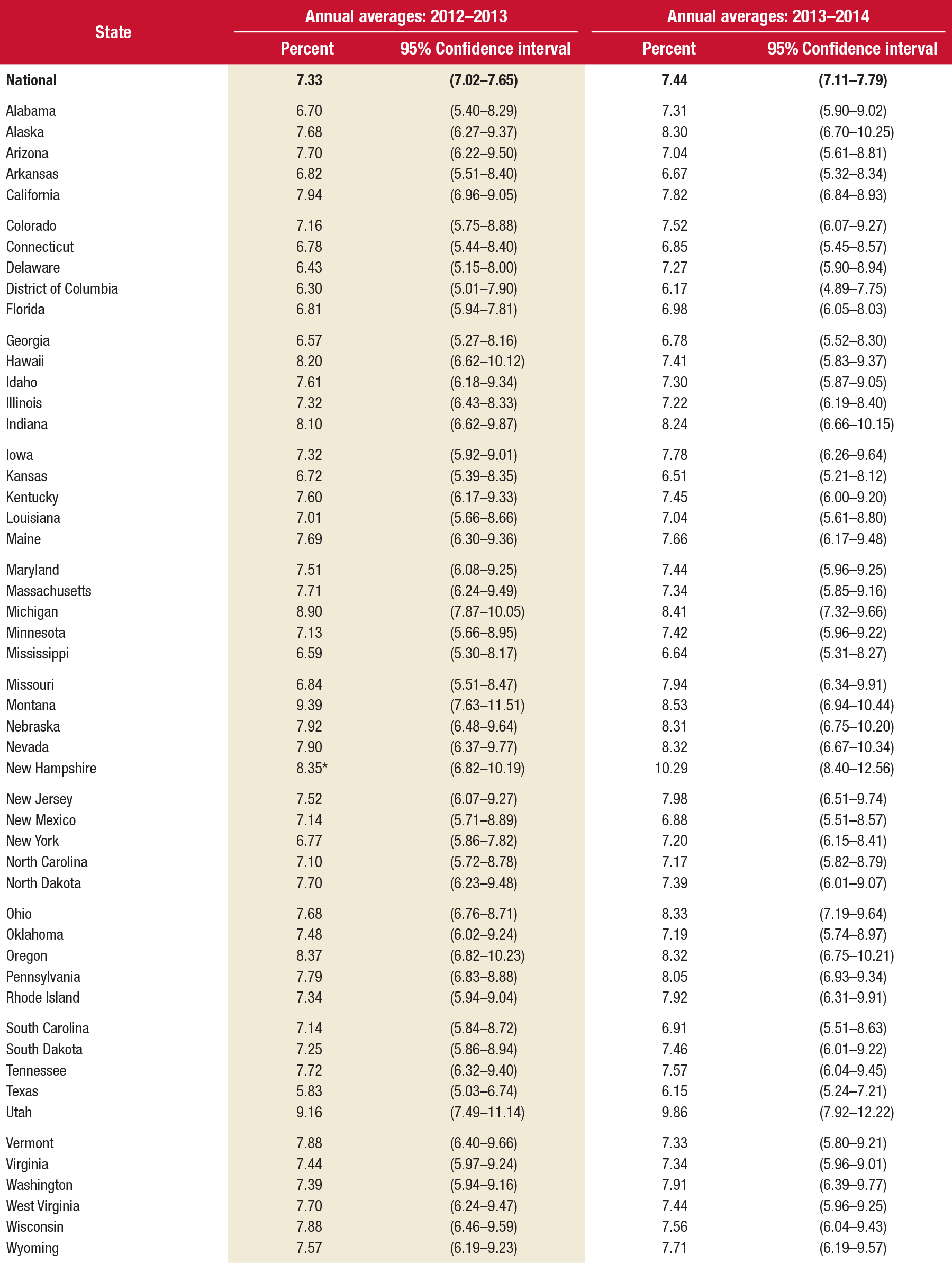
Estimates are displayed in tables and a U.S. map (Figure 1). To produce the map showing estimates of past year serious thoughts of suicide, state estimates were first rank ordered from lowest to highest and then divided into quintiles (fifths). States with the lowest estimates (i.e., the lowest fifth) are assigned to the bottom quintile and are shown in dark blue. States with the highest estimates are assigned to the top quintile and are shown in dark red. All other states are assigned to one of three quintiles between the lowest and highest quintiles. Table 1 shows the estimates associated with the map rank ordered from highest to lowest and divided into quintiles.9 For the estimates in Table 2, states are listed alphabetically. Ninety-five percent confidence intervals are included as a measure of precision for each estimate. Additionally, the combined 2013–2014 data are compared with combined 2012–2013 data to examine changes over time. The inclusion of a common year (i.e., 2013) in these comparisons increases the precision of the difference and the ability to detect statistically significant differences. Any statistically significant difference between 2013–2014 and 2012–2013 is to be interpreted as the average annual change between 2012 and 2014. All changes discussed in this report are statistically significant at the .05 level of significance.
The combined 2013–2014 NSDUH data indicate that an estimated 2.6 million young adults aged 18 to 25 in the United States had serious thoughts of suicide in the past year. This translates to about 1 in 13 young adults (7.4 percent of the population) having suicidal thoughts in the past year. There were some differences across states. Rates of young adults with past year serious thoughts of suicide ranged from 6.2 percent in Texas to 10.3 percent in New Hampshire (Figure 1 and Table 1).9
Figure 1. Serious thoughts of suicide in the past year among young adults aged 18 to 25, by state: annual averages, 2013–2014

Table 1. Serious thoughts of suicide in the past year among young adults aged 18 to 25, by quintile group and size of state estimate: annual averages, 2013–2014

Of the 10 states with the highest rates of past year serious thoughts of suicide among young adults, 5 were in the West (Alaska, Montana, Nevada, Oregon, and Utah), 4 were in the Midwest (Indiana, Michigan, Nebraska, and Ohio), and 1 was in the Northeast (New Hampshire).10 Of the 10 states with the lowest rates, 7 were in the South (Arkansas, District of Columbia, Florida, Georgia, Mississippi, South Carolina, and Texas) and 1 each was in the West, Midwest, and Northeast (New Mexico, Kansas, and Connecticut, respectively).
Nationally, there was no change in the percentage of past year serious thoughts of suicide between 2012–2013 and 2013–2014 (Table 2). At the state level, 49 states and the District of Columbia experienced no change in serious thoughts of suicide between 2012–2013 and 2013–2014. The only difference observed was in New Hampshire, where the percentage of 18- to 25-year-olds having serious thoughts of suicide increased from 8.4 percent in 2012–2013 to 10.3 percent in 2013–2014.
Table 2. Serious thoughts of suicide in the past year among young adults aged 18 to 25, by state: annual averages, 2012–2013 and 2013–2014

Overall, serious thoughts of suicide among young adults remained unchanged in 49 states and the District of Columbia and increased in one state—New Hampshire. With state-level rates of serious thoughts of suicide among young adults reaching as high as 1 in 10, despite the absence of increases, suicide remains a public health issue that transcends geographical boundaries. Behind the statistics on completed suicides are the troubling large numbers of Americans who think seriously about committing suicide every year and do not receive mental health treatment.3,4,5,11 Preventing suicide and addressing the behavioral health care needs of people at risk for suicidal behavior require public health information-sharing that raises awareness and identifies effective preventive interventions. Highlighting the prevalence of suicidal thoughts across states may help federal, state, and local policymakers continue to plan for and allocate resources to reduce the negative perceptions associated with mental and emotional issues, seek suicide prevention support, and increase access to mental health treatment.
It is critical to provide interventions for people with serious thoughts of suicide. The Substance Abuse and Mental Health Services Administration provides suicide prevention resources (https://www.samhsa.gov/prevention/suicide.aspx) and a toll-free suicide prevention hotline with free and confidential crisis counseling (http://www.suicidepreventionlifeline.org).
The combined 2013–2014 NSDUH state estimates of past year serious thoughts of suicide and 24 additional behavioral health measures are available online at www.samhsa.gov/data/. The 24 additional measures are substance use and mental health outcomes, including initiation and use of illicit drugs (e.g., marijuana, cocaine, nonmedical use of prescription pain relievers), alcohol and tobacco use, perceived great risk of harm associated with alcohol and cigarette use, substance use disorders, needing but not receiving treatment for a substance use issue, serious mental illness, any mental illness, and depression. Maps for all outcomes and tables including percentages and counts for each state and census region and the nation by age group, as well as the methodology that generated the state estimates, are provided.
Lipari, R.N., Hughes, A. and Williams, M. State estimates of past year serious thoughts of suicide among young adults: 2013 and 2014. The CBHSQ Report: - June 16, 2016. Center for Behavioral Health Statistics and Quality, Substance Abuse and Mental Health Services Administration, Rockville, MD.