In September of 2010, the Patient Protection and Affordable Care Act (ACA) extended dependent care coverage to young adults, allowing individuals under the age of 26 to remain on their parents’ insurance regardless of educational, employment, or marital status. Prior to the ACA, individuals were typically dropped from their parents’ insurance on their 19th birthday or upon their graduation from high school.1 As a result, the cohort aged 19 to 26 suffered from the highest rates of uninsurance, with approximately 30 percent of these individuals lacking coverage in the years before the ACA was enacted.2 Increasing insurance coverage among these individuals became a policy priority because lack of insurance coverage is associated with a number of adverse outcomes, including lower health care utilization rates and delay of care that often exacerbates medical conditions.3,4,5
This short report highlights the trends in mental health and substance use treatment service use by young adults aged 19 to 26 before and after the dependent care coverage extension. Examining the trends in coverage and utilization gives insight into the impact of the ACA’s dependent care coverage expansion. The results are estimates from the National Survey on Drug Use and Health (NSDUH) from 2005 to 2012.6 NSDUH, conducted by the Substance Abuse and Mental Health Services Administration’s (SAMHSA’s) Center for Behavioral Health Statistics and Quality (CBHSQ), is a survey of the civilian, noninstitutionalized U.S. population that covers a wide range of issues, including insurance coverage and use of mental health and substance use treatment services. Standard statistical t-tests of means accounting for NSDUH’s complex survey design have been conducted for all statements appearing in the text that compares estimates between years. Unless otherwise noted, all statements that describe differences are significant at the .05 level.
Figure 1 shows trends in insurance coverage for 2005 to 2012.7 Prior to passage of the ACA, NSDUH estimates indicate that insurance coverage rates among the cohort aged 19 to 26 hovered around 71 percent. This estimate is largely in line with estimates of insurance rates from other sources.2 After the dependent care coverage expansion in the second half of 2010, the NSDUH data show that young adults began to report higher rates of insurance coverage. Between the dependent care coverage extension and the end of 2012, estimates suggest an increase of 5.5 percent of young adults obtained insurance coverage. These estimates are also in line with data from other sources showing an increase in coverage of between 5.6 and 7.2 percentage points.8,9,10
Figure 1. Health insurance coverage among young adults aged 19 to 26: 2005 to 2012

Treatment service utilization is expected to increase as expanded insurance coverage removes significant cost barriers to seeking treatment.11 Figure 2 details trends in young adults reporting that they received mental health services in the previous year.12 Between the beginning of 2005 and the middle of 2010, there was a slight upward trend in rates of receipt of mental health services, with an average of 11.1 percent reporting receiving mental health services in the previous year. Prior to the coverage extension, approximately 10.9 percent of young adults reported receiving mental health services in the previous year. After the coverage extension, the trend in service rates turned sharply upward, with 11.9 percent of young adults reporting receiving services in the last half of 2012.
Figure 2. Receipt of mental health services in the past year among young adults aged 19 to 26: 2005 to 2012

Figure 3. Receipt of mental health services in the past year among young adults aged 19 to 26, by health insurance coverage: 2005 to 2012

The increase in service utilization displayed in Figure 2 was primarily driven by newly insured individuals. Figure 3 displays the percentage of young adults receiving mental health services in the previous year by insurance coverage. Receipt of service levels increased among the insured in the post-reform period. Although there appears to be a decline among the uninsured, it is not statistically significant. This suggests that the increase in service utilization was driven by newly insured young adults who previously were unable to get treatment due to lack of insurance coverage.
Unlike mental health service utilization, substance use treatment utilization did not increase in the wake of the coverage expansion. Figure 4 shows the trend in young adults who reported receiving substance use treatment in the previous year.13 Approximately 2.2 percent of young adults received substance use treatment in the last half of 2012, compared with 2.6 percent in the first half of 2010. While this appears to be a slight downward trend, the difference between the pre- and post-reform treatment levels is not statistically significant for the overall population.
Figure 4. Receipt of substance use treatment in the past year among young adults aged 19 to 26: 2005 to 2012

Figure 5 displays young adult substance use treatment utilization by insurance coverage. In the post-reform period, treatment among insured young adults remained static, averaging 2.2 percent from 2005 to 2012. However, treatment rates for the uninsured dropped significantly for uninsured young adults.
Figure 5. Receipt of substance use treatment in the past year among young adults aged 19 to 26, by health insurance coverage: 2005 to 2012

Figure 6. Cost as a barrier to treatment among young adults aged 19 to 26: 2005 to 2012

Expanded insurance coverage increases treatment utilization by lowering the cost barriers associated with out of pocket payment.11 The NSDUH data can be used to examine whether the reduction in financial barriers may be contributing to the increase in treatment utilization. Figure 6 shows the trends in young adults who reported needing mental health services or substance use treatment but who did not receive it due to cost. From 2005 to the first half of 2010, the trend in individuals who needed but did not receive mental health services or substance use treatment due to cost was increasing, reaching a high of 54 percent of in the latter part of 2009. After the enactment of the ACA, the trend turned downward, with only 44 percent of individuals needing treatment reporting that cost deterred them.
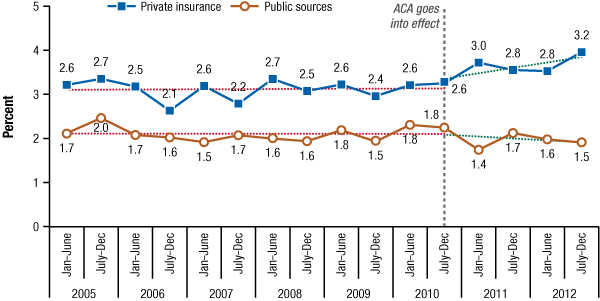
In addition to lowering the cost barriers to treatment for young adults, the extension of private insurance coverage could also shift the composition of payment sources.14 Figure 7 represents the trends in the percent of young adults reporting either private insurance or public sources used to pay for mental health services or substance use treatment.
Figure 7. Selected sources of payment for mental health services or substance use treatment among young adults aged 19 to 26: 2005 to 2012

Public source payment includes treatment paid for by the treatment center, the courts, and other public sources, or offered free of charge to the patient. Prior to the expansion of dependent care coverage, both trends were flat, with 2.5 percent of young adults reporting private insurance as a source of payment for their services/treatment and 1.8 percent reporting a public source of payment. After the expansion, private insurance began to be used more as source of payment, increasing to more than 3 percent by the end of 2012. Meanwhile, public sources of payment became less important, trending downward to approximately 1.5 percent, although this 0.3 percentage point decline is only significant at the 10 percent level.
One objective of the ACA is to address the lack of insurance as a primary cause of delaying or failing to seek care. Extending dependent care coverage to young adults is one of the tools by which the ACA attempts to accomplish this objective. After implementation of the dependent care coverage extension, insurance coverage among the targeted population increased substantially. A potential explanation for this pattern is that mental illness can be a co-morbid condition associated with substance use because individuals with mental health conditions may seek to self-medicate.15 Since individuals with both mental illness and substance use disorders frequently seek treatment in substance use programs,16, 17
this result could indicate that uninsured young adults with mental health problems sought treatment in substance use programs prior to the reform, but shifted into mental health service options once they obtained coverage in the post-reform period. Exploring this potential shift provides an opportunity for additional research. As more individuals receive mental health services, fewer may resort to illicit drugs for relief, leading to less substance use and need for substance use treatment services.18 In addition to receiving more appropriate treatment, fewer young adults reported the cost of treatment as being a barrier to seeking treatment or services. Finally, costs for treatment or services may have shifted away from the public sector and to private insurance sources.
Substance Abuse and Mental Health Services Administration, Center for Behavioral Health Statistics and Quality. (January 2013). The NSDUH Report: Trends in Insurance Coverage and Treatment Utilization by Young Adults. Rockville, MD.