 |
| August 5, 2014 |
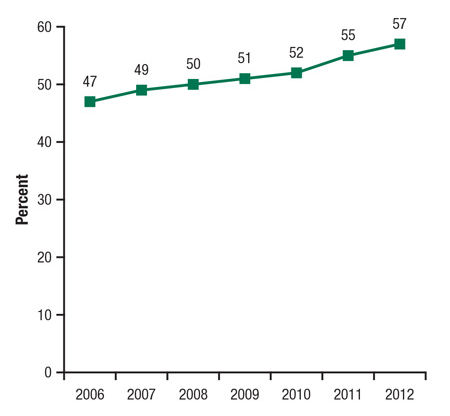
In 2012, 57 Percent of Substance Abuse Treatment Facilities Provided Community Outreach—Up from 47 Percent in 2006
Many substance abuse treatment facilities provide outreach services that are designed to help people in the community learn about the harmful effects of substance use. Outreach services are also designed to reach those who need treatment. These services can be especially important for underserved populations, such as homeless people, people living in rural areas, and people in certain racial, ethnic, or cultural groups.1,2,3
The National Survey of Substance Abuse Treatment Services (N-SSATS) is a survey of all known substance abuse treatment facilities in the United States. In 2012, 57 percent of facilities (8,205 facilities) provided outreach to the community. This is an increase from 2006, when 47 percent of facilities (6,502 facilities) provided community outreach.
Only about 11 percent of people who need substance abuse treatment receive it.4 Increasing the number of substance abuse treatment facilities that provide outreach can improve awareness among underserved populations about treatment services in their communities. Because of this, more hard-to-reach people, such as those living in rural areas or the homeless, may seek the services that they need. To learn more about community outreach, please see http://homeless.samhsa.gov/resource/assessing-the-evidence-what-we-know-about-outreach-and-engagement-37555.aspx.
 |
| Facility | 2006 | 2007 | 2008 | 2009 | 2010 | 2011 | 2012 |
|---|---|---|---|---|---|---|---|
| Facilities Providing Community Outreach | 47% | 49% | 50% | 51% | 52% | 55% | 57% |
End Notes
1 Olivet, J., Bassuk, E., Elstad, E., Kenney, R., & Jassil, L. (2010). Outreach and engagement in homeless services: A review of the literature. Open Health Services and Policy Journal, 3, 53-70. Retrieved from http://homeless.samhsa.gov/ResourceFiles/m1tifkgu.pdf
2 Chipp, C. L., Johnson, M. E., Brems, C., Warner, T. D., & Roberts, L. W. (2008). Adaptations to health care barriers as reported by rural and urban providers. Journal of Health Care for the Poor and Underserved, 19(2), 532-549.
3 Work Group for Community Health and Development. (2013). Chapter 23 (Modifying access, barriers and opportunities), Section 6 (Using outreach to increase access). In Work Group for Community Health and Development (Ed.), The community toolbox. Lawrence, KS: University of Kansas. Retrieved from http://ctb.ku.edu/en/table-of-contents/implement/access-barriers-opportunities/outreach-to-increase-access/main
4 Center for Behavioral Health Statistics and Quality. (2013). Results from the 2012 National Survey on Drug Use and Health: Summary of national findings (HHS Publication No. SMA 13-4795, NSDUH Series H-46). Rockville MD: Substance Abuse and Mental Health Services Administration.
Source: 2006 to 2012 Substance Abuse and Mental Health Services Administration (SAMHSA) National Survey of Substance Abuse Treatment Services (N-SSATS). N-SSATS is an annual survey of all substance abuse treatment facilities in the United States, both public and private, that are known to SAMHSA. N-SSATS is one component of the Behavioral Health Services Information System (BHSIS), an integrated data system maintained by the Center for Behavioral Health Statistics and Quality, SAMHSA. Information and data for this report are based on data reported to N-SSATS for the survey reference dates March 31, 2006, 2008 to 2011, and March 30, 2007, 2012. For more information on N-SSATS, see https://www.samhsa.gov/data/DASIS/NSSATS2012_Web.pdf.
The Substance Abuse and Mental Health Services Administration (SAMHSA) is the agency within the U.S. Department of Health and Human Services that leads public health efforts to advance the behavioral health of the nation. SAMHSA's mission is to reduce the impact of substance abuse and mental illness on America's communities. The Data Spotlight may be copied without permission. Citation of the source is appreciated. Find this report and those on similar topics online at https://www.samhsa.gov/data/.